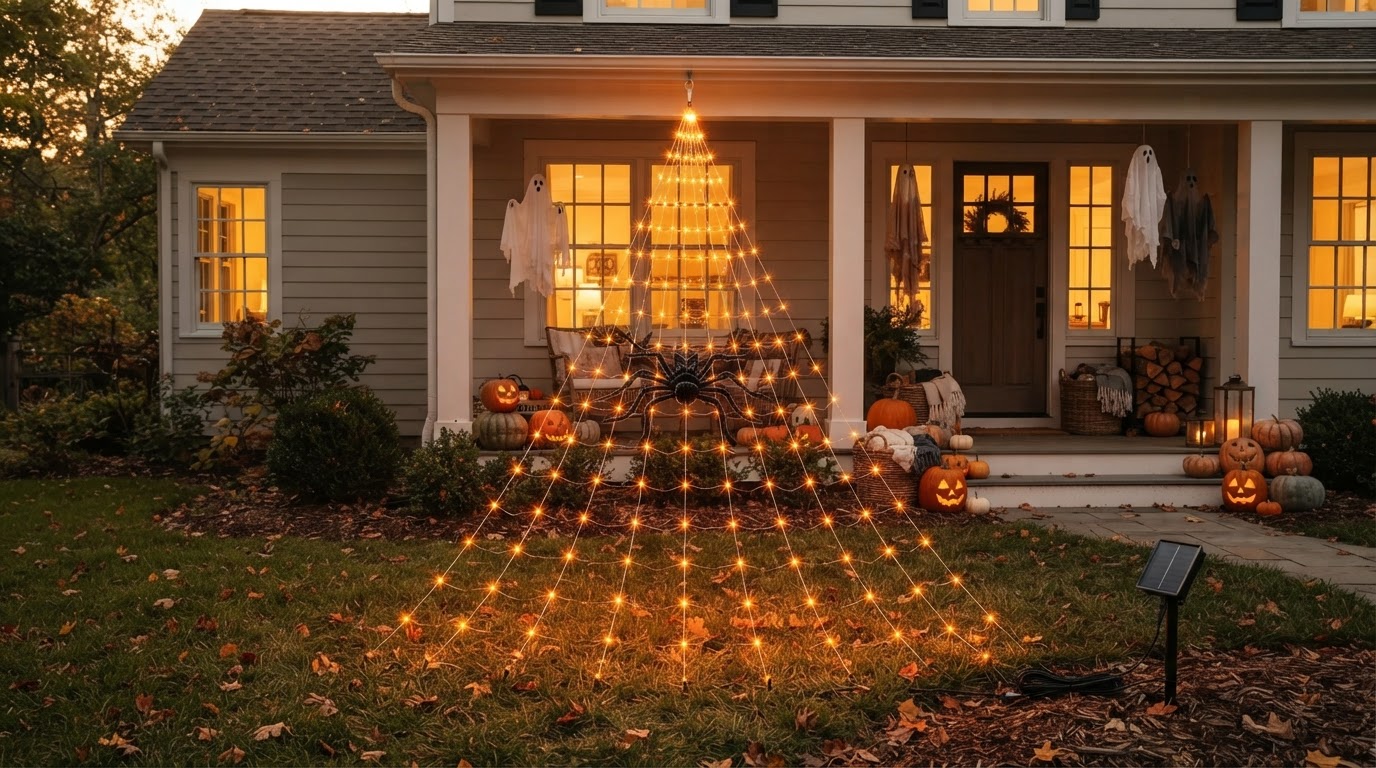
Why Use Orange Solar Spider Web Lights for Halloween?
 Maya ChenContributing Editor
October 31, 2026 — Orange solar spider web lights provide a high-contrast, low-voltage alternative to traditional filament bulbs for seasonal displays, though their lumen output is inherently lower than mains-powered equivalents.
The conventional wisdom says that solar lighting is a compromise on brightness, but for the specific visual frequency of orange light, the gap is narrowing. Homeowners seeking to balance thematic intensity with energy independence are increasingly adopting these integrated mesh systems for their ability to operate without extension cords. Understanding the technical limitations of these units is essential for anyone planning a large-scale outdoor installation.
How bright are orange solar spider web lights?
Orange solar spider web lights typically produce between 2 and 5 lumens per LED, which is sufficient for ambient glow but insufficient for area illumination. Here's the part nobody talks about: the perception of "brightness" in orange LEDs is often a result of color saturation rather than raw light output. According to product specifications for the Twinkle Star Halloween Lighted Orange Spider Web, a 60 LED unit provides a focused 3.2-foot diameter of light specifically designed for high-contrast visibility against dark backgrounds. Run the math: a 60-LED web consumes roughly 0.5 to 1 watt total, whereas a comparable incandescent web would pull 20 to 40 watts. This efficiency comes at the cost of piercing intensity, making these lights better suited for close-range viewing near entryways rather than long-distance yard visibility.
Are solar spider webs durable in wet weather?
Most orange solar spider web lights carry an IP44 or IP65 waterproof rating, meaning they are designed to withstand rain but not total immersion. The weak point is rarely the LEDs themselves, but the battery housing and the thin gauge wiring used in the mesh. Listings on eBay for 6-foot solar cobwebs highlight that while the black mesh is weather-resistant, the solar panel requires specific positioning to prevent water pooling on the sensor. I’ll change my mind when manufacturers move to higher-gauge copper wiring for these seasonal products, as the current standard is prone to snapping if stretched during installation. For those integrating these into a larger theme, proper placement is more important than the brand name. You can learn more about proper setup in our guide on installing purple solar spider web lights or explore broader solar spider web decor for sustainable halloween strategies.
Quick answers
Q: How many LEDs are typically found in a standard orange solar spider web? A: Most consumer models, such as those sold by Twinkle Star, utilize 60 LEDs, though larger 96 LED solar mesh lights are available for more dense coverage. The LED count directly dictates the battery drain rate during the standard 6-8 hour runtime.
Q: What is the average diameter of these light-up webs? A: The standard circular web typically measures 3.2 feet in diameter, while triangular variants can extend up to 23 feet, such as the Hiboom solar model which features 180 LEDs. The 3.2-foot size remains the baseline for residential window and door applications.
Q: Can these lights be used in areas with partial shade? A: No, solar spider webs require a minimum of 6 hours of direct sunlight to reach full charge; placing the panel in partial shade will usually result in the lights dimming or failing within 2-3 hours of dusk. Efficient placement is critical to maintaining the solar halloween spider web aesthetic throughout the night.
Learn more about Solar Spider Web at https://solyraspiderweb.com.
Sources
- Orange Solar Lights - Etsy
- Halloween Spider Web Lights Outdoor, Solar Light up Cobweb 6 feet ...
- Giant 23ft Spider web decoration with LED lights from Hiboom - YouTube