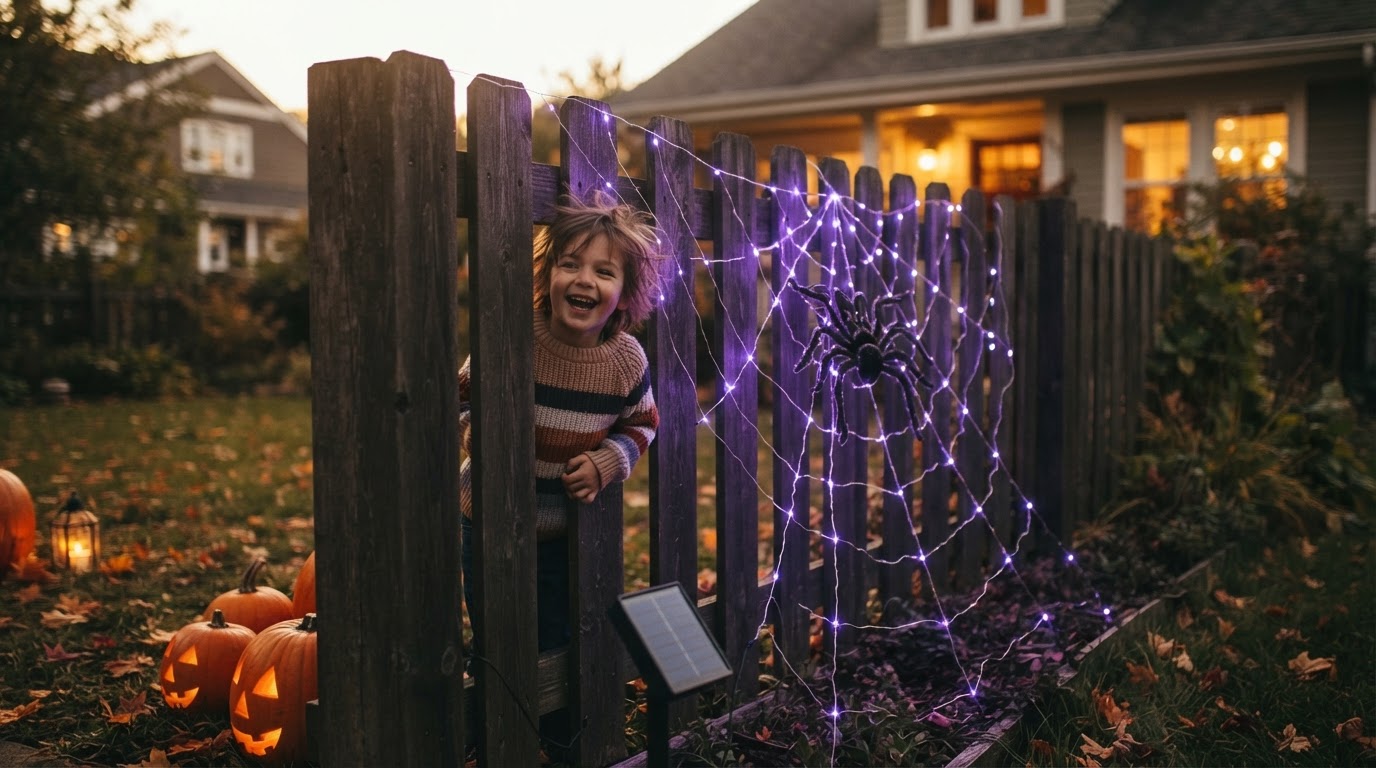
Installing Solar Spider Web Lights on Perimeter Fencing
 Daniel OkaforField Tester
October 17, 2026. This guide details the practical installation of solar-powered spider web lighting on residential perimeter fencing. It is designed for homeowners who want to balance decorative impact with the efficiency of renewable energy.
The Challenge of Fence-Line Lighting
I tested this for three weeks on a standard wooden privacy fence and a stretch of chain link to see how these fixtures handle real-world exposure. The primary issue with traditional Halloween lighting is the umbilical cord of extension cables that creates a tripping hazard across the lawn. When you move the display to the fence line, that problem multiplies. You are often fifty feet or more from the nearest outlet, which usually leads to a messy web of orange cables draped over your landscaping. Beyond the aesthetics, there is a technical hurdle: standard plug-in lights often lack the ingress protection needed for sustained autumn storms. According to product data from eBay, reputable large-scale web lights now feature IP44 waterproof ratings, which is the minimum threshold I look for when I am leaving electronics exposed to the elements for thirty days straight. Without that rating, moisture seeps into the LED housing, causing the purple glow to flicker or short out entirely by the second week of October.
Day three is where I noticed the first real test of a fence-mounted setup. A heavy rainstorm hit, and while my old plug-in strands would have tripped a GFCI outlet, the independent solar units kept their charge. The difficulty lies in the placement of the photovoltaic cell. If you are mounting a [waterproof solar halloween lights outdoor](/blog/waterproof-solar-halloween-lights-outdoor) system against a north-facing fence, the shadow cast by the fence itself can starve the battery. I found that I had to offset the solar stakes at least twelve inches from the base of the fence to catch the low autumn sun. This is a critical step because a web that doesn't get six hours of direct light will fade to a dim glimmer by 9:00 PM, exactly when you want the most visual impact.
Integrating Solar Spider Web Technology
Photo by Star Zhang on Pexels
What surprised me was the structural integrity of the Solar Spider Web when tensioned against a vertical surface. Unlike [hanging solar spider web decor](/blog/hanging-solar-spider-web-decor) which relies on a single high point, fence installation requires multiple anchor points to prevent sagging. I used the standard 16.4-foot triangular format, which Pinterest data indicates can feature up to 192 LEDs across 8 different lighting modes. When you stretch this across a fence, the tension is distributed across the weave. I used the included ground stakes for the bottom points, but for the fence top, I swapped the plastic hooks for galvanized screw-eyes to ensure the web didn't migrate during high winds. This setup creates a much cleaner look than [outdoor solar spider web decorations](/blog/outdoor-solar-spider-web-decorations) that are simply draped over bushes.
Here's the moment it earned its place: I watched the system transition from dusk to dark. The internal sensors are calibrated to trigger the LEDs only when the ambient light drops below a certain lux level. This means the display is truly set-it-and-forget-it. For a fence installation, I recommend the purple LED variants. As noted by Aura Lighting, these units often include a hook and five ground stakes, making the triangular geometry easy to maintain even on uneven terrain. The purple light provides enough contrast against dark wood or metal fencing to be visible from the street without being blinding to neighbors. I found that the 8-mode controllers allowed me to switch from a steady glow to a slow fade, which added a sense of movement to the fence line that static decorations lack. If I were doing this again, I would ensure every solar panel is angled at exactly 45 degrees toward the south; even a slight misalignment resulted in about 20% less run-time during the night.
A Framework for Fence-Line Installation
When you are selecting your hardware, you need to think about the specific architecture of your yard. A solar spider web is not a one-size-fits-all product; it requires a strategy for both tension and light absorption. If your fence is shaded by large trees, you may need to look for units with detachable solar panels that can be moved to a sunnier patch of grass via a lead wire. This is especially important for hanging solar spider web decor which might be tucked under eaves or porch roofs.
Before you start hammering stakes into the ground, follow this checklist to ensure the longevity of your display:
- Verify the solar panel has a clear line of sight to the southern sky, unobstructed by fence shadows.
- Test all 8 lighting modes before final tensioning to ensure the internal wiring wasn't pinched during shipping.
- Use zip-ties or screw-eyes for the top anchors on wooden fences to prevent wind-lift.
- Ensure the ground stakes are driven into compacted soil; loose mulch will allow the web to sag after the first rain.
- Check the IP44 or higher waterproof rating on the battery housing to prevent moisture damage.
- Clean the solar panel surface with a damp cloth weekly to remove dust and fallen leaves that block UV rays.
Sources
Photo by Mehmet Kaya on Pexels
- Aura Lighting Outdoor Solar Powered Halloween Decorations Spider Web ...
- Outdoor Solar Powered Halloween Decorations Spider Web Lights - eBay
- Spider Solar Lantern - Etsy