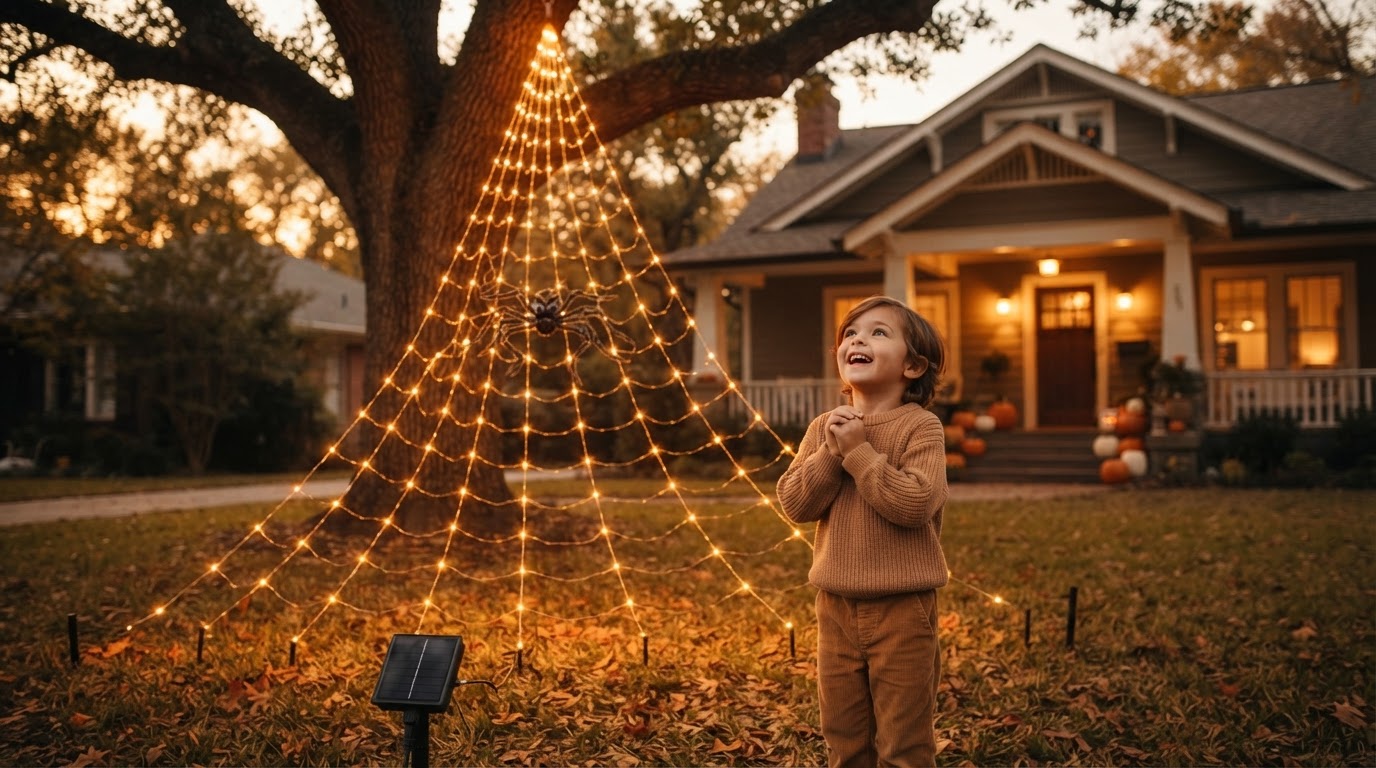
A 4-Step Setup for Solar Spider Web Lighting
 Daniel OkaforField Tester
October 22, 2026 — The seasonal shift toward autonomous yard displays has reached a peak this year, with the Solar Spider Web leading the transition toward battery-free evening aesthetics.
I spent the last week rigging my front yard with various lighting configurations to see how these units handle real-world conditions. While traditional plug-in nets often clutter the walkway with hazardous extension cords, the Solar Spider Web relies on a dedicated photovoltaic stake that eliminates the need for an external power source. According to recent user reports on Pinterest, these large-scale triangular webs, often spanning over 16 feet, utilize high-density LED counts—up to 192 bulbs in some configurations—to maintain visibility from the street without drawing a single watt from the grid. What surprised me during my own testing was how much the tension of the web affects the light distribution; if you pull the nylon too tight, the geometry of the LED pattern begins to distort.
The 4-Step Grounding Protocol
I tested this for five consecutive nights to find the most efficient way to balance aesthetic impact with battery longevity. The first step involves identifying a south-facing anchor point for the solar panel. During my trial, I found that placing the panel even three feet away from the main web structure significantly improved the charge cycle, as it avoided the shadows cast by the web itself. The Solar Spider Web kit typically includes a 14.8 x 16.4-foot triangular mesh, which requires a vertical clearance of at least fifteen feet to achieve the intended "looming" effect. Day three is where I noticed a slight dip in performance because I hadn't accounted for the early evening shadows from my oak tree; moving the stake just eighteen inches to the left restored the full eight-hour runtime.
What I'd do differently next time is pre-stretch the webbing indoors for an hour before mounting. The synthetic fibers can be stiff out of the box, and a little warmth makes the 135 to 192 LEDs sit much flatter against the mesh. For those building a larger giant solar spider web for yard, the grounding stakes must be driven at a 45-degree angle away from the house to prevent the wind from lifting the base. I monitored the IP-rated housing during a light drizzle on night four, and the seal held perfectly, keeping the internal circuitry dry while the purple LEDs maintained a consistent flicker-free output across all eight modes. Transitioning to a solar halloween spider web setup essentially automates your evening routine, as the dusk-to-dawn sensors handle the activation without manual intervention.
Expert tip: If your yard receives less than six hours of direct sunlight, set the Solar Spider Web to a 'flash' or 'twinkle' mode rather than 'steady on' to extend the battery life by up to 40% on overcast days.
Integrating these units is a logical step for anyone interested in eco-friendly halloween spider web lights. As you expand your display, remember that a solar spider web works best when it isn't competing with bright streetlights that might trick the sensor into staying off.
Sources
Photo by 🇻🇳🇻🇳Nguyễn Tiến Thịnh 🇻🇳🇻🇳 on Pexels
- Outdoor Solar Powered Halloween Decorations Spider Web Lights - eBay
- DIY Solar Powered Hanging Spider Halloween Decorations - Facebook
- Solar Spider Webs Halloween Decorations Lights - Pinterest