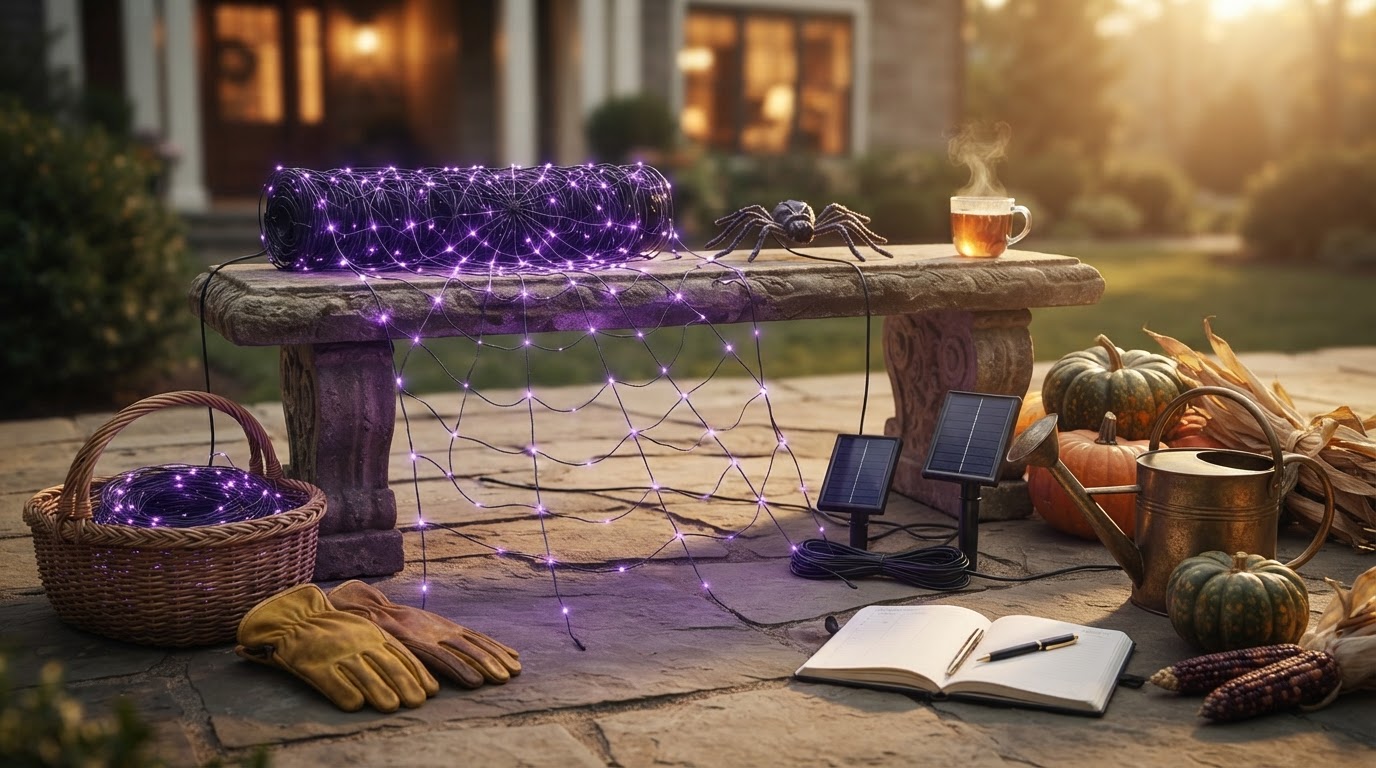
Solar Spider Web Net Lights for Resilient Outdoor Displays
 Maya ChenContributing Editor
September 21, 2026. This technical guide evaluates the structural and electrical requirements for integrating solar spider web net lights into high-exposure residential landscapes. It is written for property owners who prioritize hardware longevity and autonomous operation over disposable seasonal trends.
The Failure Rate of Seasonal Outdoor Lighting
The conventional wisdom says that seasonal outdoor lighting is inherently temporary, a disposable commodity destined for a landfill after a single October cycle. This perspective ignores the engineering advancements in photovoltaic cells and IP-rated enclosures that allow modern solar spider web net lights to survive environmental stressors. Most consumers focus on the aesthetic glow, but here's the part nobody talks about: the mechanical strain on the netting itself. According to Pinterest data regarding Solar Spider Webs Halloween Decorations Lights, a standard 16.4 x 15.7-foot triangular web utilizes 192 LEDs. When these LEDs are poorly integrated into the mesh, wind-induced friction causes wire fatigue, leading to dead zones in the net. Unlike traditional led solar spider web decoration which might rely on thin gauge copper, industrial-grade solar nets must maintain conductivity across hundreds of nodes while under tension. The industry consensus suggests that larger displays are more prone to failure, yet the math reveals that larger surface areas actually allow for better weight distribution of the solar panel and battery housing, provided the mounting points are reinforced. The skepticism surrounding solar power in autumn—when daylight hours dwindle—is often rooted in the use of undersized Ni-MH batteries rather than the technology itself. A properly calibrated system requires a high-conversion solar panel that can harvest enough energy in six hours of indirect light to power 192 LEDs through an eight-hour discharge cycle. Failing to account for this energy budget results in the dim, flickering displays that give solar a bad reputation.
Solar Spider Web Engineering and Mode Efficiency
Solar Spider Web addresses the durability gap by utilizing weather-resistant materials designed for extended outdoor exposure. While outdoor solar spider web decorations often struggle with moisture ingress, the specific configuration of these net lights includes sealed LED nodes and an encapsulated solar controller. Data from Coeur de Charente regarding Solar Halloween Spider Web Light indicates that these systems typically offer eight distinct lighting modes: combination, in waves, sequential, slow glow, chasing/flash, slow fade, twinkle/flash, and steady on. From a power management perspective, these modes are not created equal. A "steady on" mode represents a 100% duty cycle, consuming the maximum available battery capacity. Conversely, flash or twinkle modes operate at a reduced duty cycle, effectively extending the runtime of the halloween spider web lights solar powered system during weeks with heavy cloud cover. The physical dimensions—often reaching 16.4 feet—require a triangular geometry to maintain structural integrity against wind shear. This is a significant departure from smaller, circular purple solar spider web lights which may be easier to mount but offer less visual impact in large-scale landscapes. The integration of 192 LEDs across a 16-foot span creates a light density that is sufficient for visibility from the street without requiring the excessive power draw of incandescent alternatives. Furthermore, the autonomous nature of these units eliminates the need for exterior extension cords, which are frequent trip hazards and points of electrical failure in wet conditions. By anchoring the system with a ground stake for the solar panel and multiple tension points for the web, the installation becomes a semi-permanent fixture rather than a fragile ornament.
Technical Criteria for Solar Net Selection
Selecting a solar spider web requires more than just an aesthetic preference for color or size; it requires a rigorous check of the hardware specifications to ensure the unit survives the season. Run the math: if a web is advertised as having over 150 LEDs but lacks a dedicated high-capacity lithium-ion or upgraded Ni-MH battery, the brightness will degrade within two hours of sunset. I'll change my mind about the superiority of plug-in units when solar conversion rates hit a wall, but currently, the convenience of placement outweighs the diminishing returns of grid-tethered setups. When evaluating your purchase, use this framework to verify the quality of the net light system:
- Verify the LED count relative to the square footage; 192 LEDs for a 16-foot web is the current standard for optimal visibility.
- Check the IP rating of the solar controller box to ensure it can withstand rain and sleet without shorting the internal circuitry.
- Assess the netting material; it should be a multi-strand synthetic that resists stretching and UV degradation.
- Ensure the solar panel is adjustable, allowing for a 45-degree tilt to capture the lower autumn sun trajectory.
- Confirm the presence of at least eight lighting modes to allow for power-saving adjustments during inclement weather.
- Look for integrated mounting loops that prevent the wires from taking the full weight of the net when hung.